
Alien Eyes, diptych, oil on panel, 14X16 and 14X18 inches, 2025.
What does it mean to look at the world from an Alien Point of View? In “The Immense World,” Ed Yong discusses the value of trying to understand how animals other than ourselves see and experience the world. What is it like to sense magnetic waves? To hear in the infrasonic range? To emit sonar waves to sense an insect on the other side of a field? The more I attempt to imagine the world from an alien point of view, the more I find myself gazing into a dark mirror.
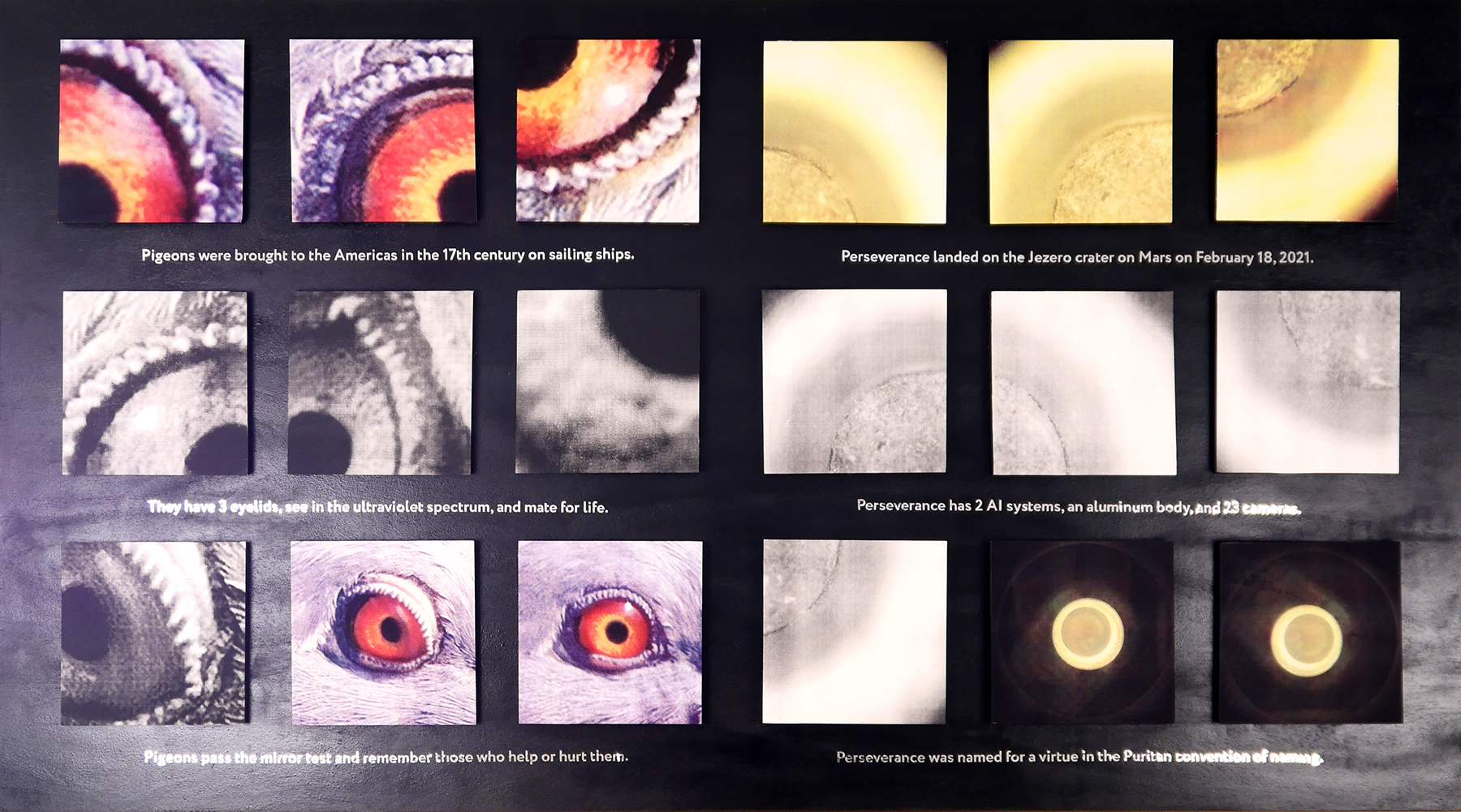
Alien Point of View, Silkscreen on panels with vinyl lettering (chrome) on plywood, 35X63 inches, 2025.
In “Alien Point of View” my starting point is a suite of 9 images taken by the Perseverance roverbot of soil samples. They are strangely beautiful in their mundanity. I have manipulated them through digitization and the silkscreen process, rendering the pixels sent to Earth from afar in layers of colored inks of the CMYK process—yellow, red, blue, and black. I pair these with a suite of 9 images of a pigeon’s eye. This doublet is part of my ongoing attempt at an admittedly one-sided collaboration with an alien robot.

Eye of Pigeon, silkscreen on lokta paper, 10X10 inches, edition of 11, 202
Jakob von Uexküll was a 20th century Baltic German biologist who proposed the idea of the umvelt, the idea that the sensory perceptions of animals are varied and thus create very different worlds: species-specific subjectivity. What is the umvelt, then, of a flying creature who sees in the ultraviolet spectrum and is sensitive to magnetic fields, using magnetoreception to find its way home? What is the umvelt of a roverbot on Mars, endowed with 2 AI systems, 8 aluminum wheels, 23 cameras, subsurface radar, and a weather detection system? All of this I try to see/imagine through my own lenses, as an animal gifted with acute trichromatic vision, but notoriously lacking in other senses. I am blind to magnetic waves, have no sub-surface radar, and cannot see in the ultraviolet spectrum.
 Deborah Santoro